Thứ Hai, 29 tháng 6, 2015

Google Earth turns 10 today

When Google Earth was first introduced 10 years ago, it immediately stole my heart. Beyond the freedom to fly anywhere in the world, I was captivated by the ability to paint and visualize geographic data on this incredible global canvas.

Drawn to datasets backed by real human stories, I started making my own maps with KML a few weeks after Earth’s release in 2005. For my master’s degree, I used Google Earth to build a virtual representation of a high-tech biological research reserve. Vint Cerf saw my work, which eventually led to a job on the Google Earth Outreach team, turning my passion for telling stories with maps into a career.

2005 was the beginning of Google Earth’s evolution, as well. In August of that year, Hurricane Katrina showed us how useful mapping tools like Earth could be for crisis response efforts. Rescue workers compared before and after Satellite imagery in Google Earth to better locate where people were stranded. And in the years after, with more than 2 billion downloads by people in nearly every country in the world, Earth has enabled people to discover new coral reefs, journey to the Moon and into deep space, find long-lost parents, clear landmines and much more.
Google Earth images of Gulfport, Mississippi's shoreline before and after Hurricane Katrina

The ability to empower groups as diverse as school children and NASA scientists to learn more about the world is what I love about Google Earth. It has the potential to make the planet a far more connected place, if you take the time to explore, discover and share what you learn. So to celebrate how far Google Earth has come and our leap into the next 10 years, we’ve created a few new ways to help you better see places from around (and above) the world.

Voyager
The world is a big place, and it can be hard to know where to begin your virtual journey. Now you can jump straight to the newest and most interesting imagery around the globe with a new layer, Voyager, available in desktop versions of Google Earth.
Different imagery types in Voyager are shown by color

In this first edition of Voyager, you’ll find five sections to explore:
  • Street View: highlights from Street View, including the Taj Mahal and the Grand Canyon
  • Earth View: striking landscapes around the globe as seen from space (more below)
  • 3D cities: a showcase of cities and towns available in photorealistic 3D (don’t forget to tilt!)
  • Satellite imagery updates: a map of our most recently published satellite imagery
  • Highlight tour: with thousands of Voyager locations to choose from, take a quick tour of a few to whet your appetite
The Kemgon Gompa—available in the Street View layer—is a Buddhist monastery in Lukla, Nepal

Earth View
Looking at our planet from above is not only a reminder of how interdependent our human and natural ecosystems are—it also lays bare the Earth’s staggering and often surreal beauty.
The Hammar Marshes of Iran are an uncharacteristic yet beautiful wetland feature in the otherwise arid climate

Earth View is library of some of the most striking and enigmatic landscapes available in Google Earth. It started as a 20 percent project last year by a few Googlers who enjoyed scouring satellite imagery for these gems. These images soon made their way onto Android phones, Chromecast and Chromebooks as a distinctive kind of wallpaper.
Islands surrounding Cuba seen in the Earth View Chrome Extension

For Earth's 10th birthday, we're expanding the Earth View collection to 1,500 landscapes from every continent and ocean and making it accessible to even more people. The new imagery is available with an updated version of our Chrome extension and a new web gallery. Download high-resolution wallpapers for your mobile and desktop devices, or better yet, print them up for your walls!
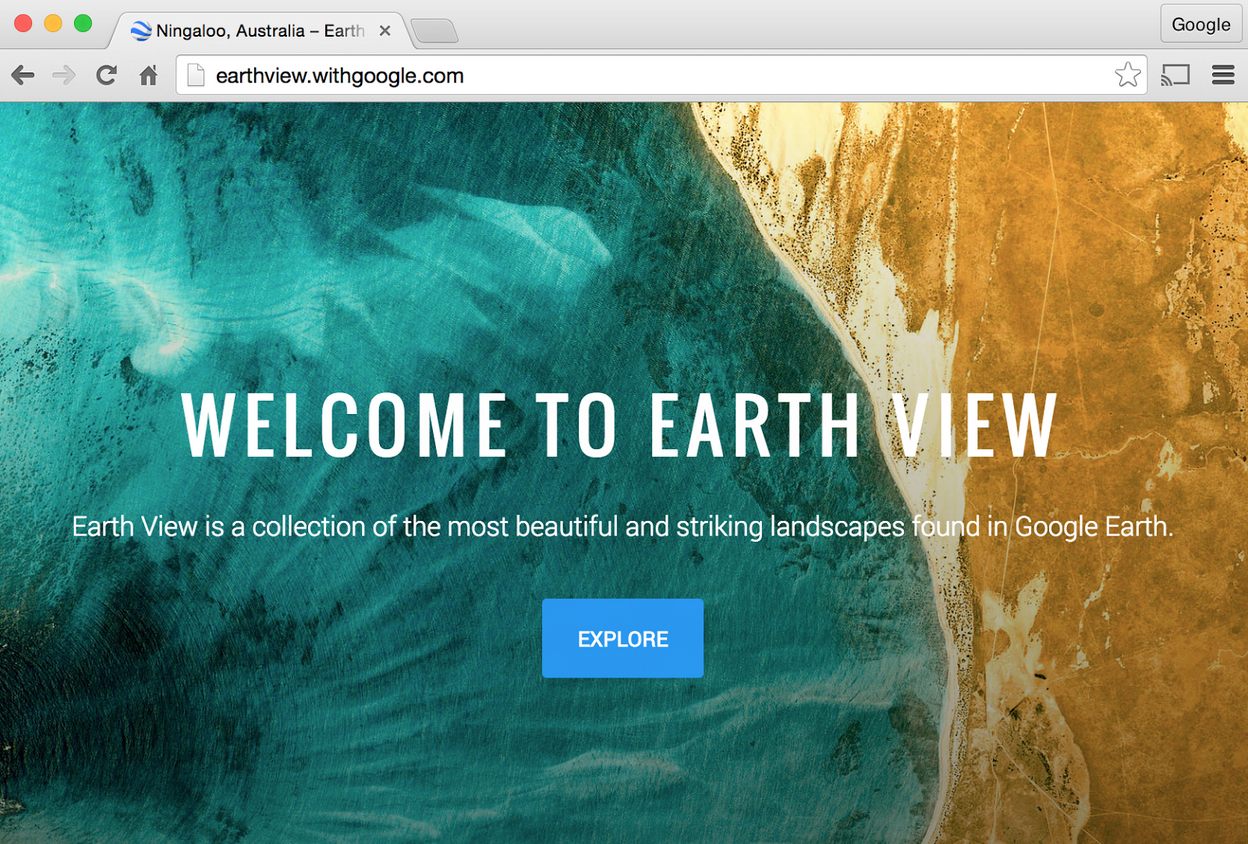
The coastline near Ningaloo, Australia in the new Earth View web gallery

Thank you for the last 10 years exploring your world with Google Earth. We hope Voyager and Earth View will unlock a new perspective on our planet. We look forward to seeing what the next decade brings!

Thứ Sáu, 26 tháng 6, 2015

Through the Google lens: Search trends June 19-25

From eagerly-awaited U.S. Supreme Court rulings, to the ongoing debate over the Confederate flag, here’s a look at some of the topics that got people searching this week.

#LoveWins
Whether the query was “marriage equality,” “fourteenth amendment,” or “love wins,” searches related to today’s U.S. Supreme Court ruling that same-sex couples nationwide have a right to marry are spiking, with more than 2 million searches for the term “gay marriage” alone. Interest goes beyond the U.S., with “What countries allow same-sex marriage?” and “where is gay marriage legal?” among the top questions.


While today’s “thunderbolt” ruling is capturing most of the attention around SCOTUS, searches for the court have in fact been big all week. Yesterday, news that the Court had upheld a key portion of the Affordable Care Act was met with a 200,000+ search spike, and renewed questions like “How does Obamacare work?” and “Why do Republicans dislike Obamacare?”

Confederate flag
We noted last week that searches related to the Confederate flag increased sharply following the tragic shooting in Charleston, S.C.; and this week, interest in the flag reached an all-time high. Searches were most concentrated in South Carolina, where Governor Nikki Haley has called for the flag’s removal from the state Capitol, followed by Alabama, where Governor Robert Bentley ordered the flag’s removal from the Capitol grounds. But searches have been popular throughout the South as people ask questions like “Is the confederate flag racist” and “How many states fly the Confederate flag?” As companies pulled Confederate flag merchandise from their sites and stores, the search terms “confederate for sale” spiked more than 1,000 percent.


Rising stars
Thursday’s 2015 N.B.A. Draft also attracted more than 2 million searches this week and half of the top 20 searches yesterday, with queries for first pick Karl-Anthony Towns spiking more than 1,000 percent. Looks like Minnesota Timberwolves fans had done their research ahead of the selection; Towns was the most-searched prospect in the state ahead of the draft. Other breakout names of the week included actor Tom Holland, who saw 500,000+ searches after he was cast as Spider-Man for the next film in the Marvel franchise. Holland’s home country of the U.K. topped the list of countries looking for details, but Spidey searches from people in the Philippines to the Netherlands show the global popularity of this character, even two years before the movie’s 2017 release.  

Thứ Tư, 24 tháng 6, 2015

A power plant for the Internet: our newest data center in Alabama

Every time you check your Gmail, search on Google for a nearby restaurant, or watch a YouTube video, a server whirs to life in one of our data centers. Data centers are the engines of the Internet, bringing the power of the web to millions of people around the world. And as millions more people come online, our data centers are growing, too.

We’ve recently expanded our data centers in Iowa, Georgia, Singapore and Belgium. And today we’re announcing a new data center in Alabama—our 14th site globally.

This time, we’re doing something we’ve never done before: we’ll be building on the grounds of the Widows Creek coal power plant in Jackson County, which has been scheduled for shutdown. Data centers need a lot of infrastructure to run 24/7, and there’s a lot of potential in redeveloping large industrial sites like former coal power plants. Decades of investment shouldn’t go to waste just because a site has closed; we can repurpose existing electric and other infrastructure to make sure our data centers are reliably serving our users around the world.
At Widows Creek, we can use the plants’ many electric transmission lines to bring in lots of renewable energy to power our new data center. Thanks to an arrangement with Tennessee Valley Authority, our electric utility, we’ll be able to scout new renewable energy projects and work with TVA to bring the power onto their electrical grid. Ultimately, this contributes to our goal of being powered by 100% renewable energy.

In 2010, we were one of the first companies outside of the utility industry to buy large amounts of renewable energy. Since then, we’ve become the largest corporate renewable energy purchaser in the world (in fact we’ve bought the equivalent of over 1.5 percent of the installed wind power capacity in the U.S.). We're glad to see this trend is catching on among other companies.

Of course, the cleanest energy is the energy you don’t use. Our Alabama data center will incorporate our state-of-the-art energy efficiency technologies. We’ve built our own super-efficient servers, invented more efficient ways to cool our data centers, and even used advanced machine learning to squeeze more out of every watt of power we consume. Compared to five years ago, we now get 3.5 times the computing power out of the same amount of energy.

Since the 1960s, Widows Creek has generated power for the region—now the site will be used to power Internet services and bring information to people around the world. We expect to begin construction early next year and look forward to bringing a Google data center to Alabama.

Vertical Street View of the world’s most iconic rock wall: Yosemite’s El Capitan

Today we’re launching our first-ever vertical Street View collection, giving you the opportunity to climb 3,000 feet up the world’s most famous rock wall: Yosemite’s El Capitan. To bring you this new imagery, we partnered with legendary climbers Lynn Hill, Alex Honnold and Tommy Caldwell. Read more about the project from Tommy Caldwell, who completed the world’s hardest climb in Yosemite in January of 2015. -Ed.

“That is awesome. I definitely have to be a part of that.”

Maybe it was the sheer exhaustion from being in the middle of a 19-day climb of the Dawn Wall, but when the guys at Google Maps and Yosemite National Park asked if I wanted to help them with their first-ever vertical Street View collection of El Capitan in Yosemite, I didn’t hesitate. Yosemite has been such an important part of my life that telling the story of El Capitan through Street View was right up my alley—especially when it meant working with the Google engineers to figure out some absurd challenges.

Climbing is all about flirting with the impossible and pushing the boundaries of what you think you can be done. Capturing Street View imagery 3,000 feet up El Capitan proved to be an extension of that, especially when you take a camera meant for the inside of a restaurant and mount it thousands of feet up the world’s most iconic rock wall.
Brett Lowell and Corey Rich capturing Street View of Alex Honnold on the King Swing

Doing anything thousands of feet high on a sheer granite face is complicated, but everyone up there had spent years of their lives on a rope and knew exactly what they were doing. After some testing, we used our tried-and-true climbing gear like cams and ropes to make sure the camera wouldn’t fall to the ground in the middle of our Street View collection.

Once we figured out how to keep the camera on El Cap, we created two sets of vertical Street View. First, we collected Street View of legendary Yosemite climbers—and my good friends—Lynn Hill and Alex Honnold in iconic spots up the sheer vertical face.

Lynn Hill’s ascent of El Capitan changed the paradigm of climbing, and she had an extraordinary effect on my climbing career. I’ll never forget when she became the first person, man or woman, to free-climb (using only her hands and feet) “The Nose” back in 1993. Now, you can see her navigate these epic moves— like climbing sideways on tiny holds of the Jardine Traverse, inventing a “Houdini” maneuver on the Changing Corners and traversing under the Great Roof.

Any story of El Capitan had to include my good friend Alex Honnold. He holds the speed record for climbing the Nose at 2 hours and 23 minutes - most people take 3-5 days. His unwavering confidence in himself is contagious; when I’m with him, I feel like the mountain has shrunk to half its size. As you make your way around Yosemite in Street View, you’ll see Alex doing what he does best: chimneying up the “Texas Flake,” racing up the bolt ladder, or getting dinner ready in the solar-powered van he calls home.

You’ll also see a glimpse of yours truly on the Dawn Wall. I spent some of my rest days during my January climb of the Dawn Wall testing out the Street View technology the Google team had sent me that month. El Cap is an intimidating environment for experimentation, but years of setting ropes proved pretty helpful in figuring out how to get the equipment rigged and ready to collect Street View.

Then, we really put Alex to work to collect the second set of Street View: the entire vertical route of “The Nose” on El Capitan. One of the few people that could do this efficiently and quickly, Alex took the camera and pretty much ran 3,000 feet up with photographer partner Brett Lowell. Now, anyone can get the beta (climbing speak for insider advice) before they climb the entire route.

Lynn, Alex and I also helped create a new Yosemite Treks page, where you can take a tour up El Cap and learn more about climbing, from what a “hand jam” is to why we wear such tiny shoes. And as a father, I’m excited kids will learn more about Yosemite when Google brings students to the park through NatureBridge later this year as a part of this project. Plus, its pretty awesome that students who can’t make it to Yosemite yet will be able to go on a virtual reality field trip to the Park with Google Expeditions.

Yosemite’s driven so much of my life that I’m excited to be able to share it with the world through my eyes. These 360-degree panoramic images are the closest thing I’ve ever witnessed to actually being thousands of feet up a vertical rock face—better than any video or photo. But my hope is that this new imagery will inspire you to get out there and see Yosemite for yourself… whether you travel up a rock wall or just down the trail.

Thứ Ba, 23 tháng 6, 2015

Music for everything you do

Need some music right now to make whatever you’re doing better? Even if you’re not already a Google Play Music subscriber, we’ve got you covered. Google Play Music now has a free, ad-supported version in the U.S., giving you a new way to find just the right music—and giving artists another way to earn revenue. In less time than it takes you to read this sentence, you could be exercising with Drop-a-Beat Workout, cooling off with Poolside Chic, or spending quality time with Songs To Raise Your Kids To.

At any moment in your day, Google Play Music has whatever you need music for—from working, to working out, to working it on the dance floor—and gives you curated radio stations to make whatever you’re doing better. Our team of music experts, including the folks who created Songza, crafts each station song by song so you don’t have to. If you’re looking for something specific, you can browse our curated stations by genre, mood, decade or activity, or you can search for your favorite artist, album or song to instantly create a station of similar music.

We hope you’ll enjoy it so much that you’ll consider subscribing to Google Play Music to play without ads, take your music offline, create your own playlists, and listen to any of the 30 million songs in our library on any device and as much as you’d like. You’ll also get ad-free, offline and background features for music videos on YouTube. And with or without a subscription, you can store and play up to 50,000 songs from your own collection for free.

To help you get started, check out the top 10 most popular activities on Google Play Music, each of which offers several radio stations to choose from based on what you like:

  1. Brand New Music
  2. Driving
  3. Working Out
  4. Boosting Your Energy
  5. Having Friends Over
  6. Having Fun at Work
  7. Entering Beast Mode
  8. Waking Up Happy
  9. Unwinding
  10. Bedtime

The new free, ad-supported version of Google Play Music is launching first in the U.S. It’s available on the web today, and is rolling out this week to Android and iOS. And while you’re checking it all out, we’ll be catching up on our Blogged 50.

Building even better communities with the Google Impact Challenge: Bay Area

What if low-income kids had the same opportunity for jobs in the tech sector as students from the best computer science departments? What could that mean for their futures, or the future of their communities?

That’s the question asked by Oakland-based Hack the Hood, whose mission is to inspire Bay Area kids to pursue careers in technology. Hack the Hood trains young people by hiring them to build websites for small businesses in their communities. After applying for the Google Impact Challenge last spring, Hack the Hood went to work with $500,000 in Google.org funding and nearly 100 Googler volunteers. In the past year they’ve expanded their programs in SF, Oakland and Richmond to reach six times as many young people.

Last year we awarded $5 million to help “hometown hero” organizations like Hack the Hood make a greater impact. Today we’re announcing the 2015 Challenge, and issuing an open call for nonprofits who are asking big “what ifs” about how they can improve their communities and put innovative solutions to work in the Bay Area.

The Bay Area region has always been defined by the people who live here: people who question the status quo to help move our communities forward. From Harvey Milk’s fight for LGBT rights to Alice Waters’ movement for sustainable food to the technological advances of Silicon Valley, the Bay Area has long been at the forefront of positive social change.

We saw this passion in the 1,000+ nonprofit proposals we received for the 2014 Impact Challenge, and we see it in the 25 finalists. We see it in C.E.O., which is training formerly incarcerated people to reenter the workforce; in Lava Mae’s commitment to bringing showers with dignity to the homeless; and in Mission Asset Fund’s providing low-income people with zero-interest loans. We see it in our neighbors who are striving for a better Bay Area for all.

As this is our home, and thousands of Googlers live and work here, we want to work together towards an even better Bay Area. The Google Impact Challenge will be accepting proposals from nonprofits through Thursday July 23, 2015 at 11:59 p.m. PDT. To learn more or to nominate a nonprofit visit g.co/bayareachallenge.

Update October 21:  826 Valencia, Bayview/Hunters Point Community Legal, City Year, The Hidden Genius Project, Kiva and the Reset Foundation received the top votes in the 2015 Impact Challenge: Bay Area. You can learn more about these organizations on our website.

Amazingly, after more than 400,000 votes—an increase of more than 2X from last year—we had a virtual tie for fourth place. So six organizations, instead of four, will each receive $500,000. Overall that means the total amount funded has increased to $5.5 million.

Congratulations to all of the nonprofits that participated in the Challenge and work every day to make the Bay Area better for everyone. And thanks to everyone who voted!

Thứ Hai, 22 tháng 6, 2015

Introducing the News Lab

It’s hard to think of a more important source of information in the world than quality journalism. At its best, news communicates truth to power, keeps societies free and open, and leads to more informed decision-making by people and leaders. In the past decade, better technology and an open Internet have led to a revolution in how news is created, distributed, and consumed. And given Google’s mission to ensure quality information is accessible and useful everywhere, we want to help ensure that innovation in news leads to a more informed, more democratic world.

That’s why we’ve created the News Lab, a new effort at Google to empower innovation at the intersection of technology and media. Our mission is to collaborate with journalists and entrepreneurs to help build the future of media. And we’re tackling this in three ways: though ensuring our tools are made available to journalists around the world (and that newsrooms know how to use them); by getting helpful Google data sets in the hands of journalists everywhere; and through programs designed to build on some of the biggest opportunities that exist in the media industry today.

Tools for better reporting
From Maps to YouTube to Fusion Tables to Earth to Search, we offer many tools that newsrooms can use in their reporting and storytelling. Now, journalists around the world can access tutorials on these products created specifically for newsrooms, at g.co/newslab. We’ll post short written and video tutorials and case studies that highlight best practices from top newsrooms around the world. As Google develops new products that help journalists, we’ll update these resources regularly. You can also get updates by following us on Twitter and Google+, and by subscribing to our YouTube channel.
Data for more insightful storytelling
There’s a revolution in data journalism happening in newsrooms today, as more data sets and more tools for analysis are allowing journalists to create insights that were never before possible. To help journalists use our data to offer a unique window to the world, last week we announced an update to our Google Trends platform. The new Google Trends provides journalists with deeper, broader, and real-time data, and incorporates feedback we collected from newsrooms and data journalists around the world. We’re also helping newsrooms around the world tell stories using data, with a daily feed of curated Google Trends based on the headlines of the day, and through partnerships with newsrooms on specific data experiments.

Programs focused on the future of media
We’re also working with partners to build a series of programs focused on imagining the future of news and information, as well as on empowering new voices in media. One of the opportunities we’re focused on is increasing the number of media startups in the marketplace. We’ve launched partnerships with Matter, a media accelerator in San Francisco, and Hacks/Hackers, a global community group for developers and journalists, to provide financial support and mentorship from Google engineers that will help these organizations expand their impact to more startups around the world. We’re also holding a series of TechRaking summits with the Center for Investigative Reporting: hackathons focused on developing new investigative tools such as drones, online databases, and more.

Another area we’ve focused our programs on is citizen reporting. Now that mobile technology allows anyone to be a reporter, we want to do our part to ensure that user-generated news content is a positive and game-changing force in media. We’re doing that with three projectsFirst Draft, the WITNESS Media Lab, and the YouTube Newswire—each of which aims to make YouTube and other open platforms more useful places for first-hand news content from citizen reporters around the world.

The News Lab is a global effort, with teams in the U.S., U.K., France, and Germany to start—and we’re also powering the training and research arm of Google’s Digital News Initiative in Europe.

Google has created many technologies and platforms that have engaged the media industry. As both the media landscape and technology continue to evolve, we believe we can create a more informed world if technologists and journalists work together—and we’re excited to be part of the effort.